

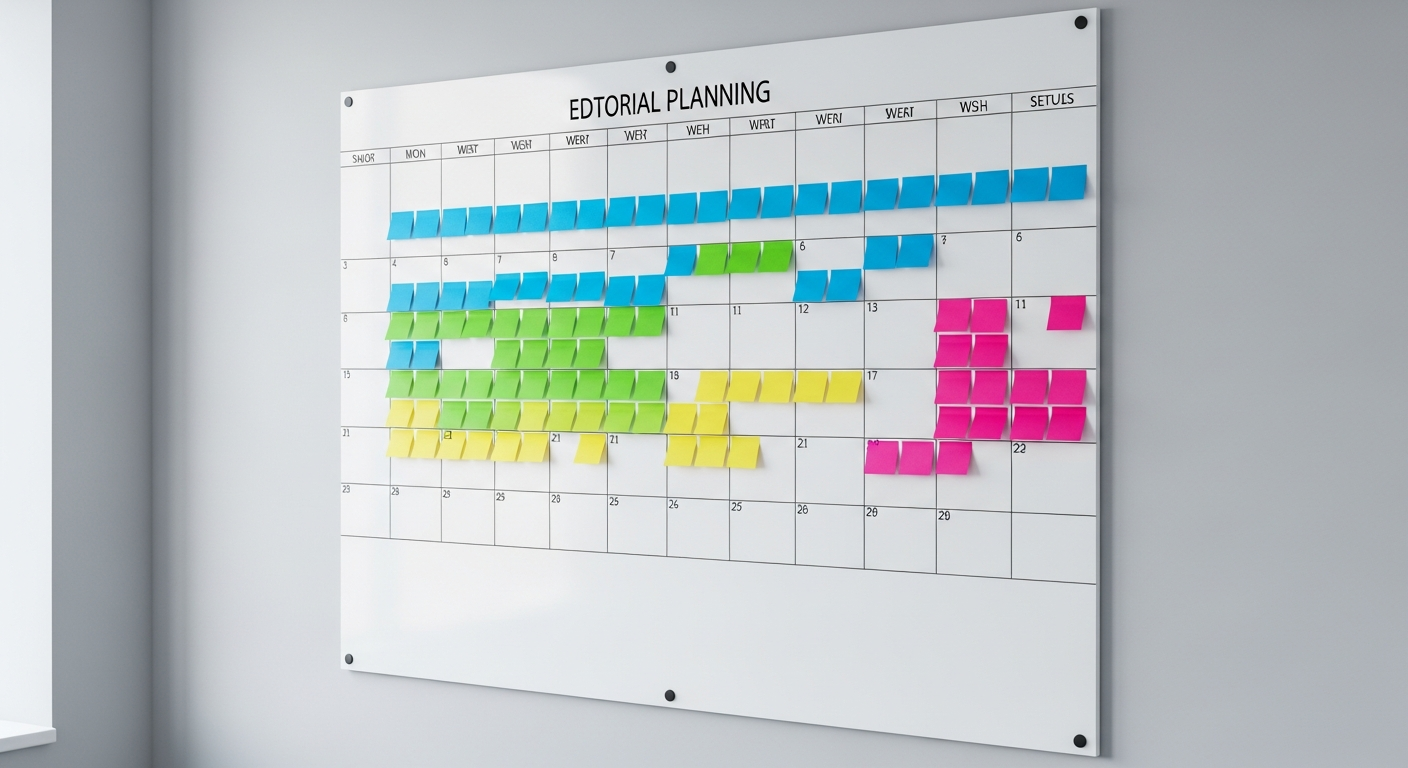
Why You Need an SEO Content Calendar
Random blogging does not build traffic. A content calendar aligns every post with a keyword, a search intent, and a business goal. It turns content from a cost center into a lead generator.
Step 1: Keyword Research Foundation
Start with data, not ideas. Identify seed keywords from your services, expand with tools, filter by volume (50+ local, 200+ broader), score by business relevance, and assess competition. Output: a ranked list of 20-50 topics.
"Our content planning starts with keyword clustering. We group related keywords into clusters, identify pillar pages, and score topics on search volume, business relevance, and content gap. That scoring determines publishing order."
Dylan Axelson, SEO Director
Step 2: Content Clustering
Group topics around pillar pages using the hub-and-spoke model. Example: our SEO services page is the pillar. Posts like how long SEO takes and how much SEO costs are supporting content. Each links to the pillar and related posts.
Step 3: Prioritization Framework
Priority Score = (Search Volume x Business Relevance x Content Gap) / Competition
Low competition + high relevance = publish first. High competition + high volume = publish after building authority.
Content Priority Scorer
Enter keyword ideas and see which to write first based on impact potential.
Priority order (highest score first)
Step 4: Choose Your Content Types
| Content Type | Frequency | Word Count | SEO Value | Lead Gen Value | Effort |
|---|---|---|---|---|---|
| Service pages | Once, update quarterly | 1,500-2,500 | Very High | Very High | Medium |
| Blog posts | 2-4/month | 1,500-2,000 | High | Medium | Medium |
| Location pages | Once per market | 1,000-1,500 | High | Medium | Low |
| Case studies | 1/month | 800-1,200 | Medium | High | Medium |
| Industry guides | 1-2/quarter | 2,000-3,000 | Very High | High | High |
| Goal | Write This | Funnel Stage | Time to Results |
|---|---|---|---|
| Rank for competitive keyword | Pillar guide | Top of funnel | 4-8 months |
| Generate leads this quarter | Service comparison post | Bottom of funnel | 2-4 months |
| Build topical authority | Supporting blog cluster | Middle of funnel | 3-6 months |
| Capture local searches | Location + service page | Bottom of funnel | 2-3 months |
| Earn backlinks | Data-driven research | Top of funnel | 1-3 months |
| Convert existing traffic | Case study | Bottom of funnel | Immediate |
Step 5: Publishing Cadence
2 to 4 posts per month for most businesses. Consistency beats volume. Publishing steadily is better than bursts followed by silence.
"We map each topic to a buyer journey stage: awareness, consideration, or decision. Every month has a mix across all three. This prevents writing only top-of-funnel content that attracts traffic but not leads."
Dylan Axelson, SEO Director
Step 6: Build Your Calendar
Sample 3-month calendar for an HVAC company:
| Week | Topic | Keyword | Volume | Type | Funnel |
|---|---|---|---|---|---|
| M1, Wk 1 | How Much Does AC Repair Cost? | ac repair cost | 320 | Blog | Consideration |
| M1, Wk 2 | Signs Your AC Needs Replacement | signs ac needs replacement | 210 | Blog | Awareness |
| M1, Wk 3 | HVAC Services in [City] | hvac services [city] | 480 | Service Update | Decision |
| M1, Wk 4 | Case Study: Energy Bill Reduction | N/A | N/A | Case Study | Decision |
| M2, Wk 1 | Heat Pump vs Furnace | heat pump vs furnace | 590 | Blog | Consideration |
| M2, Wk 2 | Spring HVAC Maintenance Checklist | spring hvac maintenance | 170 | Blog | Awareness |
| M2, Wk 3 | HVAC Services in [City 2] | hvac [city 2] | 290 | Location | Decision |
| M2, Wk 4 | How to Choose an HVAC Contractor | choose hvac contractor | 260 | Blog | Decision |
| M3, Wk 1 | FAQ: Common HVAC Questions | hvac faq | 110 | FAQ | Awareness |
| M3, Wk 2 | Ductless Mini-Split Guide | ductless mini split | 390 | Blog | Consideration |
| M3, Wk 3 | Indoor Air Quality Guide | indoor air quality | 440 | Blog | Awareness |
| M3, Wk 4 | Client Testimonial Write-up | N/A | N/A | Case Study | Decision |
Step 7: Tracking and Optimization
Track per post: rankings, organic traffic, conversions, engagement. Every 90 days, decide: update existing content ranking on page 2, or write new content. Updating a #12-ranked post is often faster than writing from scratch.
For help, explore our SEO content writing services.
Frequently Asked Questions
How many blog posts per month for SEO?
2 to 4 for most local businesses. Consistency matters more than volume.
How do I choose topics?
Keyword research. Filter by volume and competition, prioritize by business relevance.
Should I update old posts or write new ones?
Both. Update page-2 posts for fastest results. Write new content for uncovered keywords.
How long for a blog post to rank?
3 to 6 months for most posts. Lower-competition keywords can rank in 4-8 weeks. Full timeline breakdown.
Content calendar vs content strategy?
Strategy defines goals, audience, and approach. Calendar is the execution plan with specific topics, keywords, and deadlines.