

The Short Answer
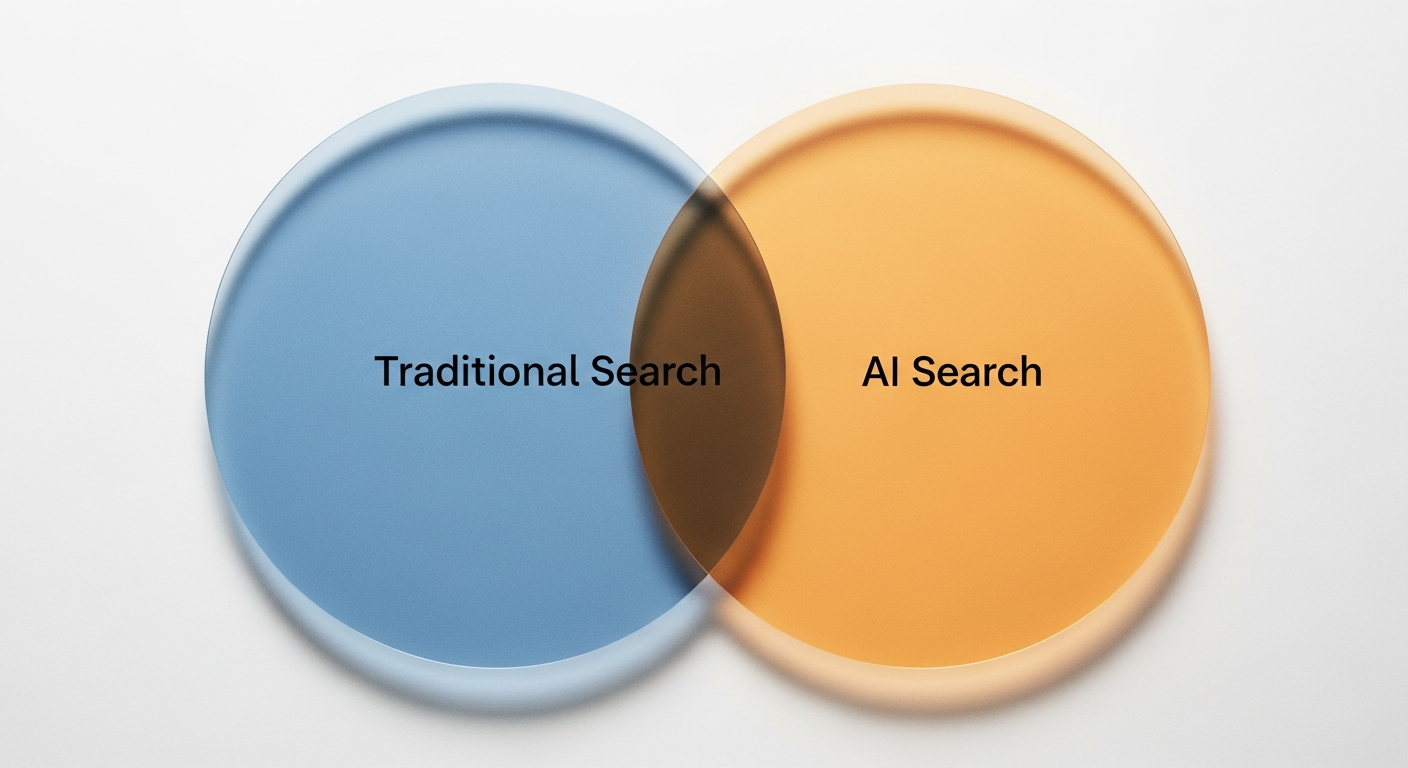
Yes, you need both. But SEO comes first. GEO without SEO is like decorating a house with no foundation. AI search engines pull from well-ranked, authoritative content. If your content does not rank in traditional search, AI has less reason to cite it.
SEO without GEO means missing a growing segment of how people search. Over 40% of Google queries now include AI Overviews. ChatGPT search is mainstream. Ignoring AI search is leaving visibility on the table.
How GEO and SEO Differ
| Dimension | SEO | GEO | Both Together |
|---|---|---|---|
| What it targets | Google/Bing organic results | AI search engines (ChatGPT, Perplexity, AI Overviews) | Full search visibility |
| How users find you | Type query, click blue link | Ask AI, see your brand cited | Every search modality |
| Key ranking factors | Backlinks, relevance, technical health | Entity authority, structured data, accuracy | Comprehensive authority |
| Content format | Keyword-optimized, long-form, topic clusters | Answer-first, FAQ, entity-rich, citation-ready | Content that ranks AND gets cited |
| Measurement | Rankings, organic traffic, conversions | AI citations, referral traffic, brand mentions | Complete attribution |
| Timeline | 3-6 months | 1-3 months for initial citations | Compounding from month 1 |
| Without the other | Misses growing AI search traffic | No foundation to build on | Maximum ROI |
| Monthly investment | $1,500-$5,000 | $500-$2,000 (add-on) | $2,000-$7,000 |
"I never recommend GEO without an SEO foundation in place. The reason is straightforward: AI search engines pull from authoritative, well-structured content. If your site does not rank well organically, AI has no reason to cite you. SEO gives your content the authority signal that GEO needs to work. Build the foundation first, then layer GEO on top." - Dylan Axelson, SEO Director
Why SEO Is Still the Foundation
AI search engines do not create information from nothing. They pull from existing web content. Google AI Overviews primarily cite pages that already rank well in traditional search results. ChatGPT search references authoritative sources. Perplexity cites multiple well-established sources per answer.
This means strong SEO makes GEO more effective. Technical SEO elements like schema markup and site structure directly feed GEO signals. SEO is the investment that pays dividends across both channels.
Why GEO Matters Now
AI search is not replacing traditional search. It is adding a new layer on top. And that layer is growing rapidly. Google AI Overviews appear on over 40% of queries. ChatGPT search usage grows month over month. Businesses that optimize for AI search today will have a significant head start over those that wait.
The data from our own site: AI search referrals have grown from zero to a measurable channel in under 12 months. We are seeing the same pattern across client sites where we have implemented GEO.
When to Prioritize Each
| Your Situation | Priority | Why |
|---|---|---|
| No SEO in place, new website | SEO first | GEO builds on SEO. You need the foundation. |
| Strong SEO, seeing AI Overview competition | Add GEO now | Protect your existing rankings from AI disruption |
| Competitive industry (medical, legal, home services) | Both | AI search is already citing competitors in your space |
| Local service business | SEO first, GEO within 3 months | Local SEO + GBP optimization, then layer GEO |
| Content-heavy site (blog, resources) | Both simultaneously | Your content is already being scraped by AI. Optimize it. |
| Ecommerce | SEO primary, GEO secondary | Product searches still dominated by traditional results |
| B2B / professional services | Both | AI search is heavily used for business research |
| Budget under $2,000/mo | SEO only | Get the fundamentals right first |
| Budget $3,000+/mo | Both | Maximize visibility across all search modalities |
The Combined Strategy Timeline
| Month | SEO Activities | GEO Activities | Expected Results |
|---|---|---|---|
| 1-2 | Technical audit, keyword research, site fixes | Schema audit, entity optimization, LLMs.txt | Foundation set, no visible results yet |
| 3-4 | Content creation, link building begins | FAQ schema deployed, answer-first content | Early ranking improvements, first AI citations |
| 5-6 | Content momentum, ranking movement | Citation monitoring, content refinement | Steady organic growth + AI visibility |
| 7-12 | Scaling content, authority building | Expanding entity signals, tracking AI referrals | Compounding results across both channels |
Budget Allocation
For businesses investing in both, here is our recommended allocation:
- SEO: 60-80% of your search marketing budget. This is the foundation.
- GEO: 20-40% of your search marketing budget. This is the acceleration layer.
GEO costs less than SEO because it layers on top of SEO work. Schema optimization, entity enrichment, and content restructuring leverage work already done for SEO. The incremental cost of adding GEO to an existing SEO engagement is significantly lower than starting either from scratch.
"When we talk to clients about budget allocation, I frame it this way: SEO is your long-term investment. GEO is how you make that investment work harder by ensuring your content shows up everywhere people search, not just in blue links. The budget split depends on industry and competition, but 70/30 SEO to GEO is a good starting point for most businesses." - Matt Russell, Co-Founder & Creative Director
Learn more about our GEO services or read our definitive What Is GEO guide.
Frequently Asked Questions
Is GEO replacing SEO?
No. GEO adds a new layer to search visibility. Traditional organic results still drive the majority of search traffic. AI search is a growing supplement, not a replacement. You need SEO as the foundation and GEO as the amplifier.
Can I do GEO without doing SEO first?
You can, but the results will be limited. AI search engines favor authoritative, well-ranked content. Without SEO building that authority, your GEO optimization has less to work with. SEO first, GEO second.
How much does GEO cost compared to SEO?
GEO typically costs $500-$2,000/month as an add-on to an existing SEO engagement. As a standalone service, it ranges from $1,000-$3,000/month. SEO is a larger investment ($1,500-$5,000/month) because it is a broader discipline.
Which delivers results faster, GEO or SEO?
GEO can show initial results (AI citations) in 1-3 months. SEO typically takes 3-6 months for meaningful ranking movement. GEO delivers faster initial visibility, but SEO delivers more volume and compounds over time.
Do I need a separate agency for GEO?
No. GEO should be integrated with your SEO strategy, not siloed. An agency that handles both ensures the strategies reinforce each other. Our team manages SEO and GEO as an integrated service.
How do I measure GEO results vs SEO results?
SEO: track rankings, organic traffic, and organic conversions in GA4. GEO: track AI search referral traffic (chatgpt.com, perplexity.ai), AI citation appearances for target queries, and branded search volume growth.